Modal verbs
Modal verbs express modality. They can express ability, possibility, necessity or other status. Auxiliary verbs are the future and the conditional. The English tenses are not enough to express ideas of possibility or uncertainty. There is no conditional tense in English. Simultaneously, auxiliaries used for conditional. Nor is there as the subjunctive tense in Spanish. Therefore, it is very important to understand the uses of modal verbs.
- can I can play the guitar.
- could Could you open the door please?
- may May I go to my home?
- might If you return tomorrow, you might see Sam.
- will Katy will definitely come to the party.
- shall Shall we buy tickets for the concert?
- should You should tell me your opinions.
- ought to Peter ought to leave now to get to college earrly.
- must The street is wet, if must have rained during night.
- would Would you like to go the cinema with me.
GRAMMAR
People should know that the grammar will help us understand other issues because this matter is related to eg language ability, since by means of grammar can speak clearly and can express our ideas in the best way.
also we can say with grammatica quee can learn the English language faster and what is most important. this is my personal opinion.


GRAMMAR IS IMPORTANT
Grammar is the system of a language. People sometimes describe grammar as the "rules" of a language; but in fact no language has rules*. If we use the word "rules", we suggest that somebody created the rules first and then spoke the language, like a new game. But languages did not start like that. Languages started by people making sounds which evolved into words, phrases and sentences. No commonly-spoken language is fixed. All languages change over time. What we call "grammar" is simply a reflection of a language at a particular time.
MODAL VERBS
Modal verbs are auxiliary verbs that can not function as a main verb, unlike the auxiliary verb "be", "do" and "have" that they can function as a main verb.
Modal verbs express modality. They can express ability, possibility, necessity or other status. Auxiliary verbs are the future and the conditional. The English tenses are not enough to express ideas of possibility or uncertainty. There is no conditional tense in English. Simultaneously, auxiliaries used for conditional. Nor is there as the subjunctive tense in Spanish. Therefore, it is very important to understand the uses of modal verbs.
- can I can play the guitar.
- could Could you open the door please?
- may May I go to my home?
- might If you return tomorrow, you might see Sam.
- will Katy will definitely come to the party.
- shall Shall we buy tickets for the concert?
- should You should tell me your opinions.
- ought to Peter ought to leave now to get to college earrly.
- must The street is wet, if must have rained during night.
- would Would you like to go the cinema with me.
MODAL COULD

In this class we worked with the modal could.
Could is an auxiliary verb, a modal auxiliary verb. We use could to:
- Talk about past possibility or ability
- Make requests
Past
General Specific Occasion+ My grandmother could speak Spanish. A man fell into the river yesterday. The police were able to save him
- My grandmother couldn't speak Spanish. A man fell into the river yesterday. The police couldn't save him.
These classes were fun because we learned new vocabulary through a game according to the theme we are seeing and should remain so fun classes. Could also say that today's topic is important to be able to communicate in a very formal way with different people.
CAN
Can generally refers to one’s ability to do something. By definition, it means:
to be able to; have the ability, power, or skill to
When using can, you will most likely be referring to this ability, power, or skill in the present or future tense. For example, “I can go to the store after dinner.” This is interchangeable with “I have the ability to go to the store after dinner.”
We use can to say that something is possible or that somebody has the ability to do something. We use can + infinitive (can do / can see etc.):
• We can see the lake from our bedroom window.
• Can you speak any foreign languages?
• I can come and see you tomorrow if you like.
The negative is can't (= cannot):
• I'm afraid I can't come to the party on Friday.
(Be) able to... is possible instead of can, but can is more usual:
• Are you able to speak any foreign languages?
MODAL MAY
USE IN REQUEST, PERMISSION.
IS MOST CONMONLY USED TO EXPRESS POSSIBILITY.
- WE MAY STAY HERE FOR THE NIGHT.
- JACK MAY BE TELLING THE TRUTH.
- YOU MAY ASK THREE QUESTIONS.
- I MAY VISIT SUSAN ON MONDAY.
- THE ROAD MAY BE BLOCKED.
. - THAT MAY BE A GOOD IDEA.
- CAROL MAY GO WHEN SHE FINISHES.

Be able to
Be able to has a similar same of CAN but be able to is mor stronger .
Although we look at be able to here, it is not a modal verb. It is simply the verb be plus an adjective (able) followed by the infinitive. We look at be able to here because we sometimes use it instead of can and could.
We use be able to:
- to talk about ability
Structure of Be able to
The structure of be able to is:subject + be + able + infinitive
| subject | be main verb | able adjective | infinitive | |
| + | I | am | able | to drive. |
| - | She | is not | able | to drive. |
| isn't | ||||
| ? | Are | you | able | to drive? |
- I was able to drive...
- I will be able to drive...
- I have been able to drive...
- I would like to be able to speak Chinese.
MODAL VERBS IN GRAMMAR
All the auxiliary verbs except be, do and have are called modals. Unlike other auxiliary verbsmodals only exist in their helping form; they cannot act alone as the main verb in a sentence.
BE, DO and, have also differ from the other auxiliaries in that they can also serve as ordinary verbs in a given sentence.
The modal verbs are:
CAN, COULD, MAY, MIGHT, MUST, SHALL,SHOULD, OUGTH TO, WILL, WOULD
Modal verbs
The modal verbs include can, must, may, might, will, would, should. They are used with other verbs to express ability, obligation, possibility, and so on. Below is a list showing the most useful modals and their most common meanings:
| Modal | Meaning | Example |
| can | to express ability | I can speak a little Russian. |
| can | to request permission | Can I open the window? |
| may | to express possibility | I may be home late. |
| may | to request permission | May I sit down, please? |
| must | to express obligation | I must go now. |
| must | to express strong belief | She must be over 90 years old. |
| should | to give advice | You should stop smoking. |
| would | to request or offer | Would you like a cup of tea? |
| would | in if-sentences | If I were you, I would say sorry. |
Might
"Might" is most commonly used to express possibility. It is also often used in conditional sentences. English speakers can also use "might" to make suggestions or requests, although this is less common in American English.
Examples:
- Your purse might be in the living room. possibility
- If I didn't have to work, I might go with you. conditional
- You might visit the botanical gardens during your visit. suggestion
- Might I borrow your pen? request
| Have to (objective obligation) We often use have to to say that something is obligatory, for example:
subject + auxiliary verb + have + infinitive (with to) Look at these examples in the simple tense:
|
MUST TO
We can use 'must' to show that we are certain something is true. We are making a logical deduction based upon some clear evidence or reason.
- There's no heating on. You must be freezing.
- You must be worried that she is so late coming home.
- I can't remember what I did with it. I must be getting old.
- It must be nice to live in Florida.
- I must go to bed earlier.
- They must do something about it.
- You must come and see us some time.
- I must say, I don't think you were very nice to him.
- I have to arrive at work at 9 sharp. My boss is very strict.
- We have to give him our answer today or lose out on the contract.
- You have to pass your exams or the university will not accept you.
- I have to send a report to Head Office every week.
OUGHT TO
The verb ought is a modal verb, which means that, grammatically, it does not behave like ordinary verbs. In particular, the negative is formed with the word not by itself, without auxiliary verbs such as do or have. Thus the standard construction for the negative is he ought not to go. Note that the preposition to is required in both negative and positive statements: we ought to accept her offer, or we ought not to accept her offer (not we ought accept or we ought not accept). The alternative forms he didn’t ought to have gone and he hadn’t ought to have gone, formed as if ought were an ordinary verb rather than a modal verb, are not acceptable in formal English. Reserve ought for expressing obligation, duty, or necessity, and use should for expressing suitability or appropriateness.
Examples:
- You ought to stop smoking. recommendation
- Jim ought to get the promotion. It is expected because he deserves it.
- This stock ought to increase in value. probability
- Mark ought not drink so much. advice against something (notice there is no "to")
WILL HAVE TO
We use the perfective will have when we are looking back from a point in time when something will have happened.
By the end of the decade scientists will have discovered a cure for influenza.
I will phone at six o’clock. He will have got home by then.
or looking "back" from the present:
Look at the time. The match will have started.
It’s half past five. Dad will have finished work.
EXAMPLES:
· She will have to go to work by bus.
· He will have to play four six hours every day.
· She will have to study hard.
Must not, Mustn't (prohibition)
We use must not to say that something is not permitted or allowed, for example:
- Passengers must not talk to the driver.
Structure of Must not
Must is an auxiliary verb. It is followed by a main verb. The structure for must not is:subject + must not + main verb
The main verb is the base verb (infinitive without "to").
Must not is often contracted to mustn't.
Look at these examples:
| subject | auxiliary must + not | main verb | |
| I | mustn't | forget | my keys. |
| You | mustn't | disturb | him. |
| Students | must not | be | late. |
You mustn't arrive late. (not You mustn't to arrive late.)
GRAMMAR IN LINGUISTIC
In linguistics, grammar is the set of structural rules governing the composition of clauses, phrases, and words in any given natural language. The term refers also to the study of such rules, and this field includes morphology, syntax, and phonology, often complemented by phonetics, semantics, and pragmatics.
The term grammar is often used by non-linguists with a very broad meaning. As Jeremy Butterfield puts it, "Grammar is often a generic way of referring to any aspect of English that people object to." However, linguists use it in a much more specific sense. Speakers of a language have in their heads a set of rules for using that language. This is a grammar, and the vast majority of the information in it is acquired—at least in the case of one's native language —not by conscious study or instruction, but by observing other speakers; much of this work is done during infancy. Learning a language later in life usually involves a greater degree of explicit instruction.
The term "grammar" can also be used to describe the rules that govern the linguistic behaviour of a group of speakers. The term "English grammar", therefore, may have several meanings. It may refer to the whole of English grammar—that is, to the grammars of all the speakers of the language—in which case, the term encompasses a great deal of variation. Alternatively, it may refer only to what is common to the grammars of all, or of the vast majority of English speakers (such as subject–verb–object word order in simple declarative sentences). Or it may refer to the rules of a particular, relatively well-defined variety of English (such as Standard English).
"An English grammar" is a specific description, study or analysis of such rules. A reference book describing the grammar of a language is called a "reference grammar" or simply "a grammar". A fully explicit grammar that exhaustively describes the grammatical constructions of a language is called a descriptive grammar. This kind of linguistic description contrasts with linguistic prescription, an attempt to discourage or suppress some grammatical constructions, while promoting others. For example, preposition stranding occurs widely in Germanic languages and has a long history in English. John Dryden, however, objected to it (without explanation), leading other English speakers to avoid the construction and discourage its use
Should
"Should" is most commonly used to make recommendations or give advice. It can also be used to express obligation as well as expectation.
Examples:
- When you go to Berlin, you should visit the palaces in Potsdam. recommendation
- You should focus more on your family and less on work. advice
- I really should be in the office by 7:00 AM. obligation
- By now, they should already be in Dubai. expectation
Using "Should" in Present, Past, and Future
Most modal verbs behave quite irregularly in the past and the future. Study the chart below to learn how "should" behaves in different contexts.| Modal Use | Positive
Forms 1. = Present 2. = Past 3. = Future |
Negative
Forms 1. = Present 2. = Past 3. = Future |
You can also use: |
| should recommendation, advisability |
1. People
with high cholesterol should eat low-fat foods. 2. Frank should have eaten low-fat foods. That might have prevented his heart attack. 3. You really should start eating better. |
1. Sarah
shouldn't smoke so much. It's not good for her health. 2. Sarah shouldn't have smoked so much. That's what caused her health problems. 3. Sarah shouldn't smoke when she visits Martha next week. Martha hates when people smoke in her house. |
ought to |
| should obligation |
I should
be at work before 9:00. We should return the video before the video rental store closes. "Should" can also express something between recommendation and obligation. "Be supposed to" expresses a similar idea and can easily be used in the past or in negative forms. |
NO NEGATIVE FORMS | be supposed to |
| should expectation |
1. Susan
should be in New York by now. 2. Susan should have arrived in New York last week. Let's call her and see what she is up to. 3. Susan should be in New York by next week. Her new job starts on Monday. |
1. Susan
shouldn't be in New York yet. 2. Susan shouldn't have arrived in New York until yesterday. 3. Susan shouldn't arrive in New York until next week. |
ought to,
be supposed to |

Should
Should is an auxiliary verb, a modal auxiliary verb. We use should mainly to:
- give advice or make recommendations
- talk about obligation
- talk about probability and expectation
- express the conditional mood
- replace a subjunctive structure
Structure of Should
subject + should + main verbThe main verb is always the bare infinitive (infinitive without "to").
| subject | auxiliary verb | main verb | |
| + | He | should | go. |
| - | He | should not | go. |
| shouldn't | |||
| ? | Should | he | go? |
Should: Giving advice, opinions
We often use should when offering advice or opinions (similar to ought to):- You should see the new James Bond movie. It's great!
- You should try to lose weight.
- John should get a haircut.
- He shouldn't smoke. And he should stop drinking too.
- What should I wear?
- They should make that illegal.
- There should be a law against that.
- People should worry more about global warming.
HAD BETTER
We use “had better” plus the infinitive without “to” to give advice. Although “had” is the past form of “have”, we use “had better” to give advice about the present or future.
- You'd better tell her everything.
- I'd better get back to work.
- We'd better meet early.
- You'd better not say anything.
- I'd better not come.
- We'd better not miss the start of his presentation.
- You should brush your teeth before you go to bed.
- I shouldn't listen to negative people.
- He should dress more appropriately for the office.
- You shouldn't say anything.
- I should get back to work.
- We should meet early.
- You'd better do what I say or else you will get into trouble.
- I'd better get back to work or my boss will be angry with me.
- We'd better get to the airport by five or else we may miss the flight.
Modal verb definition
The following list are all modal verbs
Modal verbs are also sometimes called modals.
They are used before ordinary verbs and are used to express meanings such as permission, possibility, certainty and necessity.
Need and dare can be used as like modal verbs
| Can Be able to Can't Could May Might Must | Have to Need to Needn't Musn't Don't have to Should Ought to |
Modal verbs examples and meaning
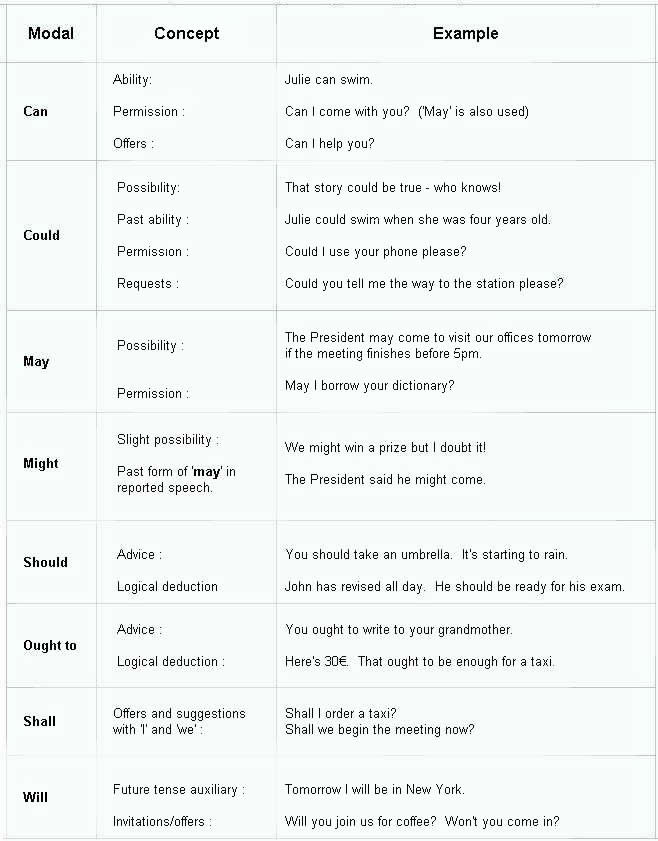
Modal auxiliaries can, may, must
We use modal auxiliary verbs can, may, must in the English language for various meanings - ability, possiblity, probability, certainty, permission, prohibition, obligation, opinion, speculation, etc.
Can
1. It is used to express the ability to do something.I can swim very well.
Can he speak English fluently? - No, he can't.
We cannot sing at all!
2. It expresses the possibility to do something.
We can go to the seaside at last. Our holidays start next week.
3. We use it to say that something is probable.
It can be John. He has blond hair and he is wearing glasses.
4. It expresses the permission to do something.
Why not? You can marry her. She is a nice girl.
May
1. It is used for permissions.You may borrow my car. I won't need it.
May I smoke here? - No, you can't, I'm sorry.
2. It is used to express probability or prediction.
They may call tomorrow. I hope so.
The main difference between may and can is in style. May is more formal than can. Can is typical of spoken English.
3. The opposite of may is must not or may not.
May I smoke here?
- You mustn't smoke here. (strong prohibition)
- You may not smoke here. (more polite, very formal)
- You can't smoke here. (informal spoken English)
Must
1. It is used for strong obligations. It is personal, because it expresses the speaker's opinion or will.
I must clean my teeth. I want to be healthy.
You must go there. And do it right now!
2. It means a strong recommendation.
You must see it. It's the best film I've ever seen.
3. We use it to show the certainty of the speaker.
They must be at school by now. It's already 9 o'clock.
4. The opposite of must is need not.
Mum, must I wash up? - No, you needn't. I've already done it.
Must nothas a different meaning. It is used to express prohibition that involves the speaker's will.
We mustn't come late today. Or the teacher will be very angry.
He mustn't enter this room. It is dangerous.
Note
Normally, these modal auxiliary verbs are not used in different tenses. The past tense of can is could, may and must, however, only have the present form. All the other tenses must be formed in a different way.
We make the passive voice with averb + be+ past participle:This can be done. The laws must be respected.
Needn't, don't need to, don't have to
We can use need as an ordinary verb or as a modal verb. As a modal verb it doesn’t change its tense and doesn’t add –s for the third person singular.
- I needed to leave early (ordinary verb)
- You needn’t speak so loudly (modal verb)
- I’ve already cleaned the car so you needn’t bother to do it
- Judges in England need not retire until they are 75
- Need you go so soon? (modal verb, lees common and rather formal)
- You needn’t cut the grass, I’ll do it later
- You don’t need to be over 18 to get into a disco
- You needn’t whisper.
- Nowadays it needn’t cost a fortune to own a powerful computer
Use: necessity
GENERAL
EXAMPLES:Students don't usually have to pay tax.
You need to get a visa before you travel.
PRESENT AND FUTURE TIME
EXAMPLES:I have to finish this report today.
We can't find a babysitter; we'll have to stay in tonight.
You needn't write it now. You can do it later.
NOTICE: We also use have got to for present and future necessity
PAST TIME
EXAMPLES:There were no buses. I had to get a taxi.
He said that they had to go.
NOTICE: The meanings of have to, need to and needn't are not exactly the same
There are certain words in English that are usually followed by an infinitive or gerund. If you are not sure whether to use the infinitive or gerund, check out our lists or look the words up in a dictionary.
Infinitive
Use
Certain words are followed by an infinite verb with or without ‘to’.| Use and Word Lists | Example |
|---|---|
| as the subject of a clause | To know you is to love you. |
| after certain expressions (without ‘to’) | Why not go to the cinema? |
| after certain verbs (without ‘to’) | I can swim. |
| after certain verbs (with ‘to’) | He wants to swim. |
| after certain verbs with interrogatives (infinitive constructions) | They don’t know how to swim. |
| after certain verbs with objects (without‘to’) | He made her swim. |
| after certain verbs with objects (with ‘to’) | They wanted him to swim. |
| after certain adjectives and their comparisons | It’s easier to swim downstream. |
| after nouns deriving from the verbs mentioned above | We made a promise to swim. (derived from the verb ‘to promise’) |
Phrasal verb
The term phrasal verb is commonly applied to two or three distinct but related constructions in English: a verb and a particle and/or a preposition co-occur forming a single semantic unit. This semantic unit cannot be understood based upon the meanings of the individual parts in isolation, but rather it can be taken as a whole. In other words, the meaning is non-compositional and thus unpredictable. Phrasal verbs that include a preposition are known as prepositional verbs and phrasal verbs that include a particle are also known as particle verbs.One can discern at least three main types of phrasal verb constructions depending upon whether the verb combines with a preposition, a particle, or both. The words constituting the phrasal verb constructions in the following examples are in bold:
-
- Verb + preposition (prepositional phrasal verbs)
- a. Who is looking after the kids? – after is a preposition that introduces the prepositional phrase after the kids.
- b. They pick on Joseph. – on is a preposition that introduces the prepositional phrase on Joseph.
- c. I ran into an old friend. – into is a preposition that introduces the prepositional phrase into an old friend.[5]
- d. She takes after her mother. – after is a preposition that introduces the prepositional phrase after her mother.
- e. Sam passes for a linguist. – for is a preposition that introduces the prepositional phrase for a linguist.
- f. You should stand by your friend. – by is a preposition that introduces the prepositional phrase by your friend.
-
- Verb + particle (particle phrasal verbs)
- a. They brought that up twice. – up is a particle, not a preposition.
- b. You should think it over. – over is a particle, not a preposition.
- c. Why does he always dress down? – down is a particle, not a preposition.
- d. You should not give in so quickly. – in is a particle, not a preposition.
- e. Where do they want to hang out? – out is a particle, not a preposition.
- f. She handed it in. – in is a particle, not a preposition.
-
- Verb + particle + preposition (particle-prepositional phrasal verbs)
- a. Who can put up with that? – up is a particle and with is a preposition.
- b. She is looking forward to a rest. – forward is a particle and to is a preposition.
- c. The other tanks were bearing down on my panther. – down is a particle and on is a preposition.
- d. They were really teeing off on me. – off is a particle and on is a preposition.
- e. We loaded up on Mountain Dew and chips. – up is a particle and on is a preposition
- f. Susan has been sitting in for me. – in is a particle and for is a preposition. We often use verbs with these words:
on off in out up down away back over about round forward through along We often use these words (particles) with verbs of movements. For example:get on The bus was full. We couldn't get on. drive off She got into the car and drove off. came back Tom is leaving tomorrow and coming back on Saturday. turn round When I touched him on the shoulder, he turned round. But often these words (on / off / up / down etc.) give a special (an idiomatic) meaning to a verb. For example:
- Sorry I'm late. The car broke down.
- Look out! There's car coming.
- It was my first flight. I was very nervous as the plane took off.
- It was so tired this morning that I couldn't get up.
- How did you get on in your examination yesterday?

Experience the electrifying excitement of Lottery Live draws directly on the KhelRaja platform. Our live stream feature brings the draw room to your screen, providing an unmatched level of transparency and adrenaline. Watch the winning numbers emerge in real-time and feel the rush as your life-changing jackpot is announced. This commitment to a live, immersive feed is part of our promise to offer the best gaming experience. Join the KhelRaja community for the most authentic and thrilling live lottery action available online.
ResponderEliminarNGO Experts provide clear and reliable guidance on the complete process to register NGO. Their team simplifies every step, from documentation to compliance, so you feel confident and supported throughout. I appreciate their professional approach and quick responses to queries. If you want smooth NGO registration without confusion or stress, NGO Experts is a trustworthy partner to rely on.
ResponderEliminar